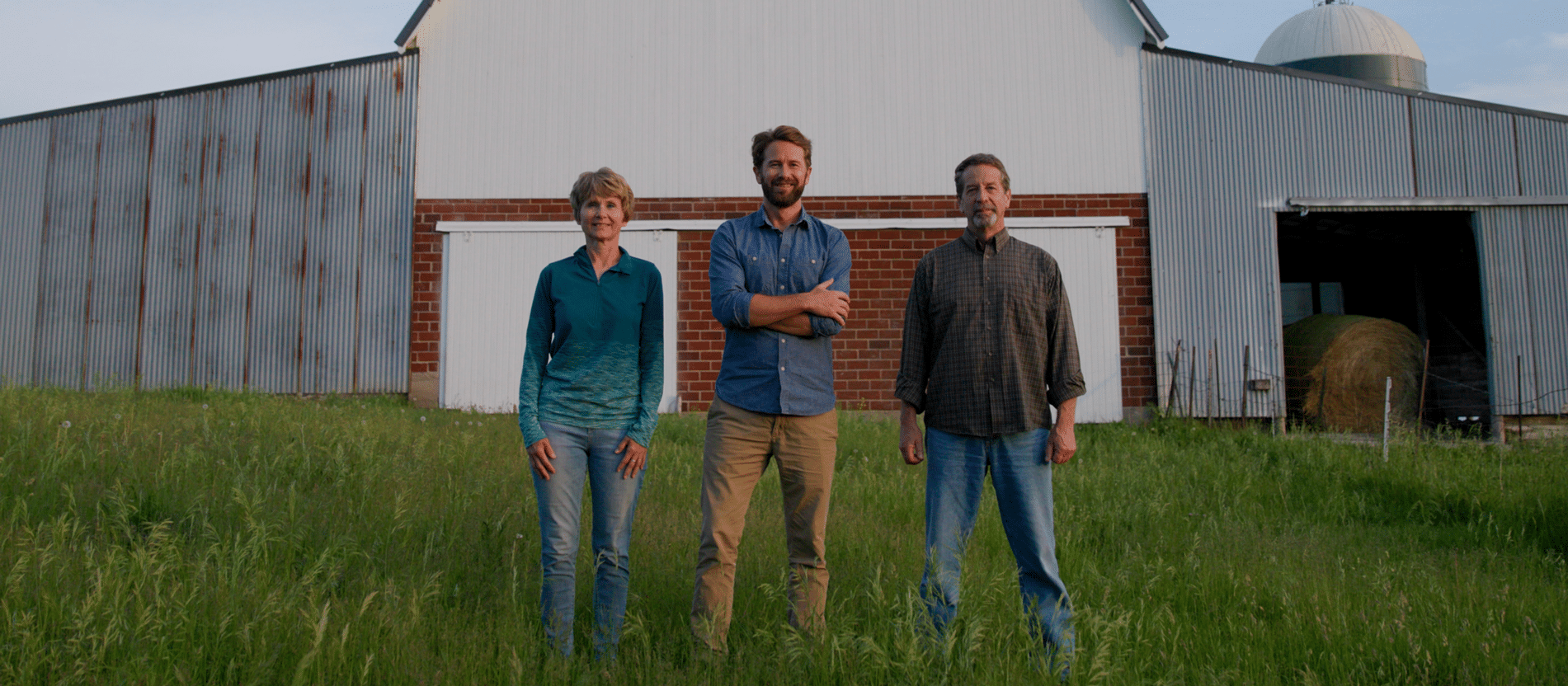
Transfarmation Opens its Second Demonstration Hub in Iowa
The Transfarmation Project® is thrilled to announce the opening of its second demonstration hub at 1100 Farm in Radcliffe, Iowa. The hub is a thriving specialty mushroom operation located at a farm that once raised an estimated 8,000 pigs per year. This milestone is not only a significant achievement for Transfarmation and 1100 Farm. It’s also a significant beacon of hope that it’s happening in Iowa, the nation’s biggest factory farming state.
In collaboration with the Transfarmation™ team, contractors, and consultants, the Faaborg family successfully converted one of the farm’s hog barns into a space for growing specialty mushrooms.
What Is a Demonstration Hub?
The demonstration hub is a former confined animal feeding operation (CAFO) that has been converted into a specialty crop farm. The hub provides a space for research, hosts visitors interested in alternatives to factory farming, and showcases the potential of farm transitions to create viable opportunities for former industrial animal farmers.
This launch has been at least three years in the making, though Transfarmation’s work with the Faaborg family dates back to 2021. Together, we are thrilled to demonstrate how transitioning out of factory farming is not only possible but profitable and sustainable.
Setting the Stage in Iowa
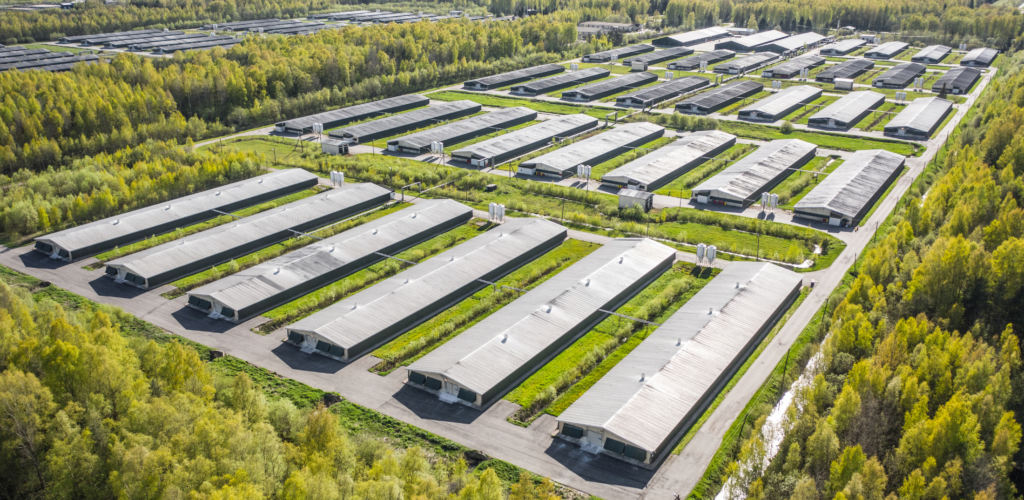
Iowa is ground zero for factory farming in America. Home to 4,000 CAFOs, it’s the leading state for the production of pork, poultry, eggs, and corn. Hogs outnumber humans seven to one. Chickens are even higher at 16 to one. The result? Factory farms in Iowa produce a combined 300 million pounds of manure every day. That’s 25 times higher than what’s produced from the entire human population in the state.
The state’s waterways are amongst the highest in the country for nitrate pollution. This problem is directly linked to the state’s agricultural production. Not entirely unrelated, Iowa is also a leading state for new cases of cancer. In this landscape, the opening of 1100 Farm and Transfarmation’s second demonstration hub is nothing short of a miracle. With the opening of this hub, we are embracing a simple truth: The Heartland can be the center of the food future our communities deserve.
About the Farmers
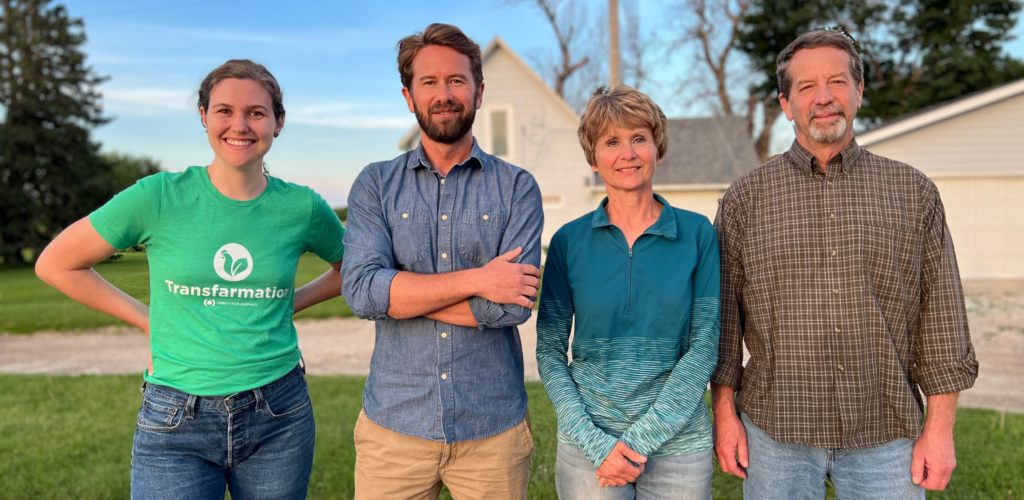
For 30 years, Tammy and Rand Faaborg raised pigs on their land. Their operation started with just a few pigs and eventually grew into a CAFO, or factory farm. Working with an integrator, the Faaborgs built two barns, each housing 1,100 pigs. Their five kids, including Tyler and Tanner, also grew up working on the farm. But over time, the family felt like it was time for a change.
In June 2021, the Faaborgs began work with Transfarmation. One year later, the family made the bold decision to stop raising pigs to pursue a full farm conversion. Transfarmation awarded the family with a grant in 2023 to pursue a pilot mushroom-growing project. It was a huge success.
The family really took ownership of the process and even started making their own mushroom blocks. In addition to fresh mushrooms, they found a market for mushroom tinctures, jerky, coffee, and hot chocolate blends. In 2025, a feature in The New York Times significantly boosted the family's sales, resulting in nearly 1,000 orders in the first few days after publication.
With those successes in the rearview, the Faaborg family was finally ready to expand and scale up their production. That meant breaking ground on a complete overhaul of one of their hog barns.
The Faaborgs took on most of the construction themselves. Armed with a passion for agriculture and a thirst for change, they were very hands-on throughout the entire conversion process. With every completed step, the bigger picture of social and environmental change began to come into clearer view.
“It takes unimaginable courage to look at a multi-decade family business and say, 'We need to find a better way.’ But that is exactly what the Faaborgs did. Theirs is a story of ecological and personal healing. This hub is a living testament that we don’t have to tear down our agricultural heritage to build a better future. The Faaborgs have shown us that a food system that works for farmers, animals, and the planet isn't just a dream—it's already happening.”
—Katherine Jernigan, Director of Transfarmation
The Faaborgs are now at the forefront of mushroom cultivation. After transitioning with the support of Transfarmation, their story provides an opportunity to explore how a shift from factory farming can lead to both economic stability and environmental sustainability.