If you’re a person who eats food, especially locally-grown food, we have to talk about the Farm Bill. In short, it dictates agriculture and food policies and programs. Among other things, it determines what types of farming are well-funded and which are not.
The Farm Bill influences what crops are planted, how farmers are supported, and it even affects what you and I pay at the grocery store. It’s a piece of legislation that is supposed to be revisited every five years, but our government hasn’t successfully passed a new version since 2018. While it’s true that a Farm Bill is desperately overdue, it’s important that a finalized version addresses some of the problems farmers face today.
The House of Representatives just passed its version of the Farm Bill by a vote of 224-200. Now, it heads to the Senate.
Farmers are struggling while corporations thrive. The House Farm Bill prioritizes Big Ag oligarchies at the expense of producers. Meaningful relief for the rural communities bearing the brunt of skyrocketing prices is also absent.
This Farm Bill also attacks states’ rights and wipes out local animal welfare laws. If passed, it could force farming communities to accept factory farming rules and would overturn Prop 12, which banned the use of gestation crates in industrial pig farming and established a minimum floor space requirement for veal calves and egg-laying hens.
But at a basic level, this Farm Bill simply fails to address the key problems plaguing our food system.
The simple answer is that this bill seems to be written to protect the status quo. It tightens Big Ag’s grip on our food system. It ignores “specialty crops,” or the important fruits and vegetables needed in every diet. The Farm Bill could also weaken important environmental conservation programs by limiting the number of farmers who can access them.
To get a little more granular, here are four big issues;
Our government is funneling power and taxpayer dollars to massive agribusiness corporations. This Farm Bill prioritizes shareholder value and bottom lines over small farmers, national food security, and affordability.
We need to fight for a better food system. That looks like prioritizing land access for new farmers, investing in local food networks, and strengthening independent and small-scale farmers. Earlier this year, the Department of Health and Human Services advised us to “Eat Real Food.” The thing is, we can’t get there unless those “real foods” receive support.
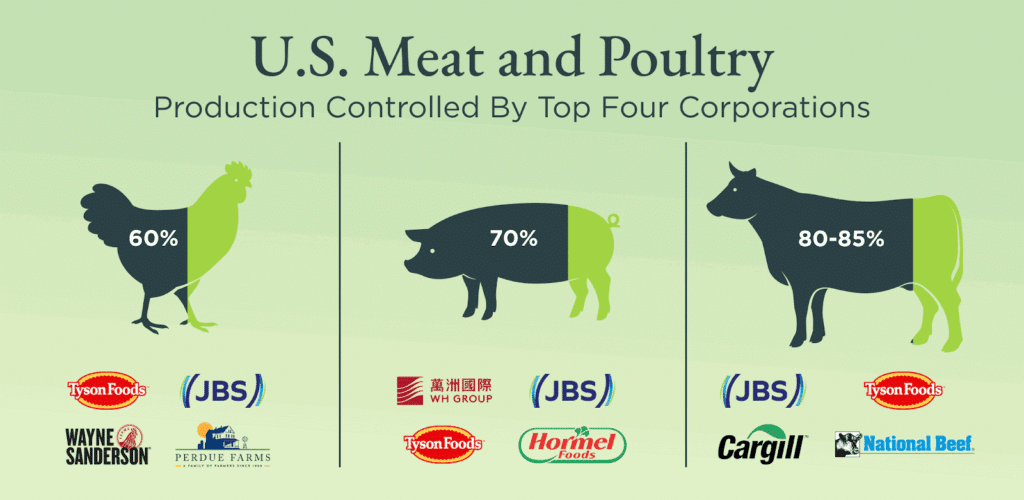
As long as the big four meatpacking companies hold an effective monopoly over our food system, our nation will struggle with resilience, sustainability, and food security. Enforcing anti-trust laws and empowering localized food systems should be a key pillar of the Farm Bill.
Similarly, specialty crop farmers desperately need more substantial support. Studies show strong correlations between the crops planted and the availability of subsidies. That means farmers want to grow the crops that have the most support. So when we talk about fruits and vegetables, we see that much of the produce on grocery shelves is imported from other countries. A big reason is that farmers are neither incentivized nor protected to grow them.
These are some of the biggest and most important protections farmers need, but there are other considerations, too. For example, a good Farm Bill would include support for regenerative farming practices, sustainability, and environmental protections. It would strengthen farmers' economies, better protect farming communities, and increase protections for animal welfare.
For the sake of simplicity, we can just say that a good Farm Bill looks nothing like the one that is currently under consideration.
Right now, taking action against the latest Farm Bill is essential. Each of us has an opportunity to make a difference in defending farmers and our food systems right now. We can start by getting the word out.
Here’s how:
Don’t miss your opportunity to make your voice heard on this. If the Farm Bill passes, it will affect farmers, food, and our economy for years to come.